
Mapping Investor Types and Behavior: An introduction for Asia-Pacific IR Teams

Shifting market dynamics, driven by the aftermath of the pandemic, escalating geopolitical tensions, and a growing wave of activism across Asia, have reshaped the investment landscape. Meanwhile, rapid technological advancements have turbocharged how investors engage and evaluate opportunities, further adding to the complexity.
All of these factors have forced or inspired some investors to change, revise, or upgrade their investment philosophies. As investors reposition themselves, listed companies and IR teams, particularly those most focused on investor relations, have also made adjustments. In this article, we will explore why treating all investors the same way can result in missed opportunities and weaker engagement. Understanding what investors prefer and their behaviors is key to maintaining strong relationships. We will also discuss the unique challenges faced by APAC-listed companies, from complex regulations to cultural diversity and varying levels of data transparency.
Last but not least, we will discuss how adopting a more tailored, data-driven approach to investor relations can help companies strengthen their investor base, maintain consistency in IR operations, and enhance their position through knowledge and intelligence when engaging with the C-suite.
Investor Typology in APAC
The typology of investors in APAC is quite similar to that in North America regarding public equities. In both cases, we see institutional investors, strategic individuals, retail, and corporate accounts. Where the differences become very apparent is in the distribution of holdings. According to an OECD Capital Market Series analysis from 2024, it shows that Asia (excluding Japan and China) has a more balanced distribution of investors. Meanwhile, China and Hong Kong seem to be dominated by large portions of retail and institutional investors, respectively. Institutional investors account for only 9% of holdings in China, whereas they make up 32% in Japan, for example.
Among institutional investors, we are seeing more advanced, tech-reliant investment strategies starting to emerge in APAC. While these strategies, such as the so-called Quantamental strategies that combine systems and fundamental analysis, have been common in North America for some time, their rise in APAC is a more recent development. We will introduce how IR teams can position themselves for such new strategies.
Although the traditional classification criteria, such as time horizon and risk tolerance, have not changed, there is clearly a shift in how data is handled, including automation and geography focus.
At the South China Morning Post Greater Bay Area China conference in 2025, our founder hinted that "The Rise of Chinese Investors" is gradually compensating for the reduced appetite from foreign investors. This represents a search for Asian specialists with deep pockets and highly technical skills who understand the region better and appreciate its originalities. This shift is coming to life in the first months of 2025, with more than 60% of IPOs and structured product subscriptions in Asia coming from regions led by China and Hong Kong investors.
However, not all changes are positive. The pursuit of strong gains in sectors like AI has led to some concentration risk, deviating from traditional diversification strategies.
Unique Challenges for APAC-listed Companies
Cultural and market diversity. A recent example shared at an Irostors IR luncheon was the case of a Japanese institutional investor, who often prioritizes long-term stability and conservative growth, versus China-based investors, who might have a higher risk tolerance but are also more sensitive to regulatory changes. Additionally, we see differences between countries, with some investors favoring formal, relationship-based communication, while others expect flexibility and more informal, spontaneous engagement.
Regulatory and legal complexity also presents a challenge. Unlike other major economic blocs that often have unified regulatory systems, APAC markets are subject to multiple regulatory frameworks, including capital controls and stricter reporting and disclosure rules. The composition of the investor base is also diverse and requires agile IR teams to use targeted communication methods for each investor group.
As mentioned earlier, the distribution between retail and institutional investors across market cap, type, and geography requires IR teams to have targeted communication methods for different investor groups. At Irostors, we see challenges as opportunities. While some markets have already established higher governance standards, others still struggle to go beyond the basic norm. This results in investor concentration in a handful of companies that have extensive and consistent communications.
Geopolitical sensitivities, though always present, have recently become more pronounced. While there was an initial acceptance of the situation, since 2019, we’ve seen a resurgence of geopolitical sensitivities, with companies looking to revitalize and even reinvent their institutional investor base. This ties back to the earlier point about the growing importance of Asia-focused investors.
Investor Behavior Decoded
In this highly diversified environment, how can IR teams map investor behavior? In some cases, the solutions may not be specific to APAC but can still provide a helpful framework for companies to engage with their investor base.
We’ve put together a cheat sheet to help our IR partners map the 'who, what, how, and why' of investor behavior. This cheat sheet serves as a simplified map to help IR teams improve or restructure their engagement strategies.
| Investor Type | What Drives Their Investment Decisions | Preferred Communication Methods | Triggers for Disengagement/Sell |
|---|---|---|---|
| Retail Investor (Conservative) | Focus on stable, low-risk investments, income generation (dividends, bonds). Often driven by macroeconomic trends, regulatory stability, and brand reputation. | Periodic updates, focus on clear and simple reports. Prefers newsletters, email updates, and traditional media (TV, print). Minimal reliance on digital channels. | Sells on poor economic forecasts, sudden volatility, changes in regulatory environment, or unexpected risks that threaten income stability. |
| Retail Investor (Growth-Oriented) | Driven by potential for capital appreciation, high growth sectors (tech, biotech), and market trends. Tends to favor high volatility in search of high returns. | Frequent updates, mobile apps, social networks (e.g., Reddit, Twitter), and online content (e.g., blogs, YouTube videos). Short-form videos, infographics, and interactive content. | Sells on missed growth targets, market sentiment shifts, poor earnings reports, or negative news regarding high-growth sectors. |
| Institutional Investor (Asset Managers) | Focus on portfolio diversification, long-term value creation, risk-adjusted returns. Primarily guided by asset allocation models, historical data, and market cycles. | Formal communication such as quarterly reports, earnings calls, 1-on-1 meetings with senior management. Preferences for structured data and clear financial metrics. | Sells on strategic misalignment, underperformance relative to benchmarks, poor financial results, or a failure to meet long-term goals. |
| Institutional Investor (Hedge Funds) | Focus on high-risk, high-reward opportunities, short-term capital gains, and aggressive strategies (e.g., leverage, shorting, arbitrage). Strong preference for market inefficiencies. | Frequent, detailed updates, access to high-level meetings with management and strategy teams. High demand for real-time market data and detailed risk analysis. | Sells on a failure to execute aggressive strategies, poor market timing, insufficient operational transparency, or inadequate return on short-term trades. |
| Family Offices | Prioritize capital preservation, long-term stability, and strategic investments in ESG-focused sectors. Multi-generational wealth management with a focus on legacy and governance. | Periodic, personalized communication with direct access to senior leadership. Preference for annual meetings, board-level discussions, and tailored reports. | Sells on poor performance, deviations from long-term investment strategy, misalignment with family values or governance, and poor ESG performance. |
| Activists | Driven by governance issues, underperformance relative to competitors, or missed strategic opportunities. Strong focus on maximizing shareholder value through strategic changes. | Direct communication, often demanding board-level engagement or meetings with C-suite executives. Typically confrontational and high-pressure discussions. | Sells if governance issues are ignored, if management fails to implement required changes, or if there’s persistent underperformance without corrective actions. |
| Sovereign Wealth Funds (SWF) | Long-term investment horizon, strategic alignment with national interests, risk diversification, and commitment to sustainable investment principles and ESG goals. | Formal, institutional communications, quarterly/annual reports, governance reports. High-level access to management for strategic alignment and policy discussions. | Sells on poor governance, misalignment with national or portfolio strategy, geopolitical instability, political risk, or weak long-term returns. |
Targeting Strategy
To develop a targeting strategy, we remind our IR partners at Irostors of the importance of the "6+ Touchpoint" rule. In other words, the IR team should be consistent in reaching out to each type of investor at least six times (or more) before expecting serious engagement. This means that the IR team, to be diligent, will allocate significant resources to ensure no potential investor is left behind. This is what we at Irostors like to call being "Investor-Obsessed".
The following illustration helps IR teams at a glance to compare resource allocation based on investor typology and behavior.
| IR Resource Allocation | Investor Type | Resource Focus | Key Actions/Resources |
|---|---|---|---|
| Retail Investors | High Volume, Short-Term Focus | Engage with a larger, diverse investor base. Focus on consistent updates and education. | Frequent and easy-to-digest updates via mobile apps, email newsletters, social media. Utilize digital channels to engage and capture attention. |
| Institutional Investors (Fundamentals) | Long-Term, Value-Oriented | Prioritize transparent, detailed communication with focus on fundamentals, governance, and strategy. | Provide quarterly and annual reports, direct access to leadership (for large caps), 1-on-1 meetings, and perception studies. |
| Family Offices | High Net-Worth, Long-Term Focus | Build personalized relationships, focusing on stability, capital preservation, and ESG considerations. | Personalized quarterly updates, access to leadership, customized financial reports. |
| Activists | Short-Term, Strategy-Focused | Ensure governance transparency, respond to underperformance concerns, and engage in direct, action-driven communication. | Direct meetings, responsive engagement on governance and operational issues, ad-hoc meetings based on specific concerns. |
| Sovereign Wealth Funds (SWF) | Large Scale, Strategic, Long-Term | Align with national interests, long-term returns, and geopolitical considerations. Provide insights into market stability. | Periodic formal reports, regular updates on geopolitical and economic risks, tailored access to senior leadership. |
| ESG Investors | Sustainability-Focused | Align communication around long-term sustainability goals and risk management strategies. | Provide detailed ESG reports, sustainability updates, clear communication on impact investing initiatives. |
Storytelling
Storytelling in investor relations is where science meets art. It’s where the IR team works to grow the investor base and eventually monopolize investor relations. By analyzing three years of communication data at Irostors, we have observed that companies with the most success in investor engagement tend to have a core equity story focused on the vision, growth potential, and market differentiation, while incorporating data-driven elements around sustainability and financial performance. These IR teams start from a core equity story, then tailor the narrative for different investor groups—growth for some, stability and dividends for others, and even a turnaround story for a few. These IR teams ensure they emphasize topics that matter most to their targeted investor base while addressing the specific concerns of that population.
One of the new elements of differentiation that we have also observed is that IR teams are versioning their communications to cater to bots and scraper systems, which are continuously scanning social networks, news, and company websites in search of information. This growing trend is indirectly establishing a link between IR teams and system traders, but in a way that offers agile corporate IR teams an opportunity to control what gets fed to the machine. Our mind map below suggests ways to start with a core equity story and extend it into five versions to cater to different investor types.
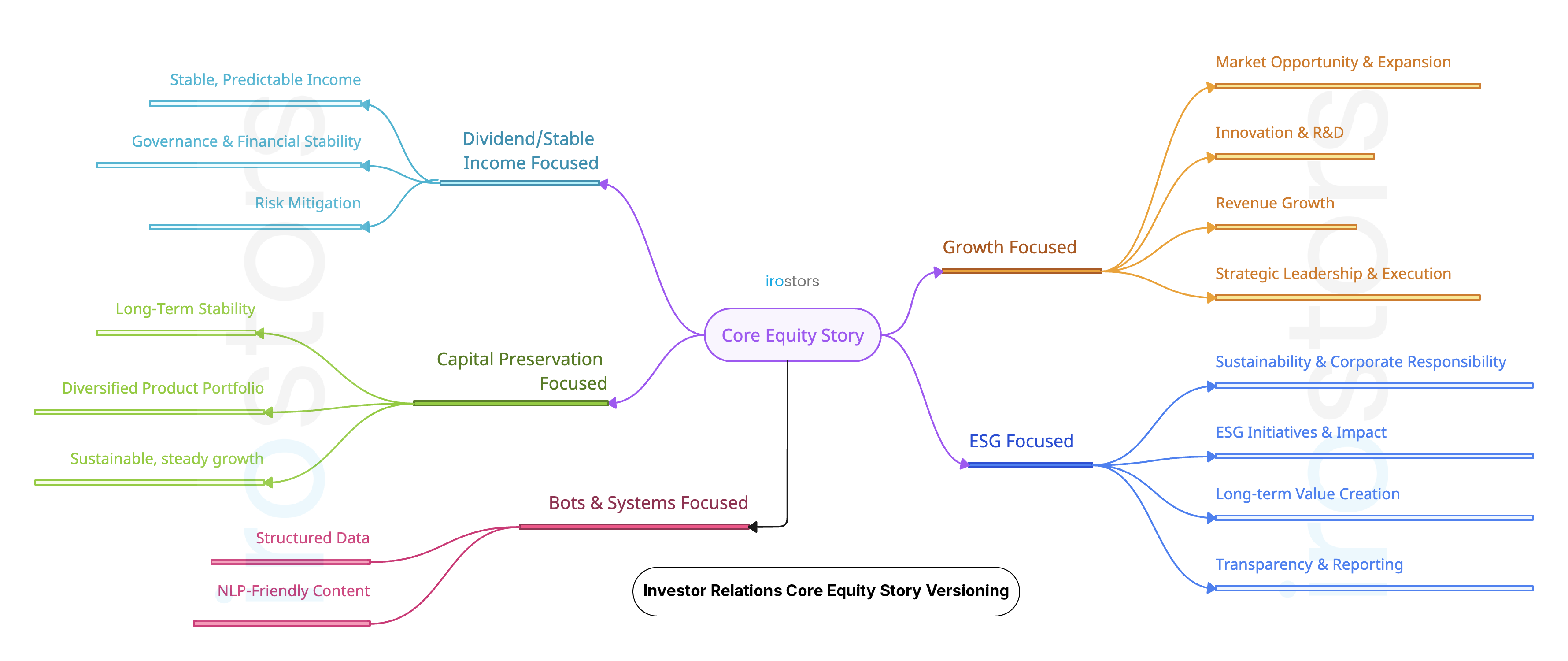
For instance, a decision by an electric vehicle components manufacturer to finance expansion through debt in response to increasing demand could be perceived as a risk or negative by retail investors due to concerns over leverage. However, institutional investors may view this as a strategic move to capitalize on growth opportunities, potentially leading to higher returns, provided the company demonstrates robust financial management and a clear path to debt repayment.
Investor Distribution and Engagement Channels
Now it’s time to ask ourself: What is our investor base distribution? How invested is our team in making sure we reach out to each investor group with tailored content and through the appropriate channels?
When it comes to channel strategy, we’ve previously touched on different channels based on investor typology and behavior. Now, let’s explore in more detail some of the most commonly used channels: one-on-ones, roadshows, virtual events, and social networks.
One-on-Ones
One-on-ones are ideal for institutional investors, family offices, and activists who need customized, in-depth discussions. These meetings can be highly efficient in building trust or triggering investment decisions, but they are often difficult to secure. At Irostors, we’ve identified that consistency in communication and a great knowledge of the existing investor base are key elements in making one-on-ones successful.
One-on-ones also provide a unique opportunity for information sharing. Want to know what investors think of your stock? Tell them what others think of it.
Roadshows
Roadshows are essentially a series of one-on-ones executed overseas, but we highlight them here as a separate tool for engaging international investors. Roadshows serve dual purposes: business development and investor care at the leadership level. Investors sometimes book roadshow meetings due to fear of missing out on a development, and this provides an opportunity for the corporate team to engage them at a critical moment. Some corporates, using Irostors, go as far as assigning specific copies for different types of investors and use the system’s RSVP capabilities to manage the workload of handling investor requests and feedback.
The same rule applies to roadshows: the more touchpoints, the more chances of getting roadshows booked.
Virtual Events
Virtual events, unless addressing overseas institutional investors, should be prioritized for retail investors or broad institutional engagement. These are great tools for updating investors on earnings, performance reviews, or general company updates. Virtual events are location-agnostic, making them a cost-effective and accessible way to gauge investor engagement.
Conferences
Today in APAC, corporates have the opportunity to participate in events organized by the sell side, especially for those with institutional coverage. For those without consistent institutional coverage throughout the year, a growing number of specialized companies in Asia can help listed companies participate in conferences to increase visibility.
Social Media
While social media IR presence has traditionally been focused on retail investors, it is now becoming more important across all investor types. Nowadays, social media presence helps corporate brands manage perceptions and control the narrative, enabling them to even directly influence the algorithmic decisions that drive investor behavior.
Corporate website:
A well-maintained IR website ensures that investors can easily access accurate, up-to-date information at their convenience. It also acts as a primary touchpoint for retail investors, institutional investors, and even analysts who are researching the company. With the increasing focus on transparency, a company's website must be user-friendly and mobile-responsive to provide a seamless experience for global investors.
Conclusion
Tailored communication is essential for building strong investor relationships. As we’ve discussed, classic investor types each—whether retail, institutional, family office, or activist—has its own set of priorities. Adapting to these needs, with customized content and versioned documents, helps ensure that the right information is always delivered in the right way.
Being flexible with communication channels also matters. Whether we’re using one-on-ones, roadshows, virtual meetings, or social media, it’s crucial for us to understand which channel works best for each investor group and adjust to their changing preferences. But above all, the key to success is consistency. Keeping up regular contact and providing consistent updates is how we build trust and loyalty over time.
The core of a strong IR strategy is being “investor-obsessed.” This goes beyond the numbers— we believe,mit's about creating a communication approach that’s transparent, accessible, and tailored to what each investor cares about. By continuously fine-tuning your approach, staying agile, and listening to feedback, companies in APAC can create lasting relationships and ensure they stay on track for long-term success.
Follow us on Linkedin
Companies mentioned
Sectors mentioned